AI Won't Replace You. Someone Using AI Will.
You’ve seen the headlines. “AI is taking over.” “Millions of jobs at risk.” “The robots are coming.”
It’s enough to make you want to close the browser and pretend none of it is happening.
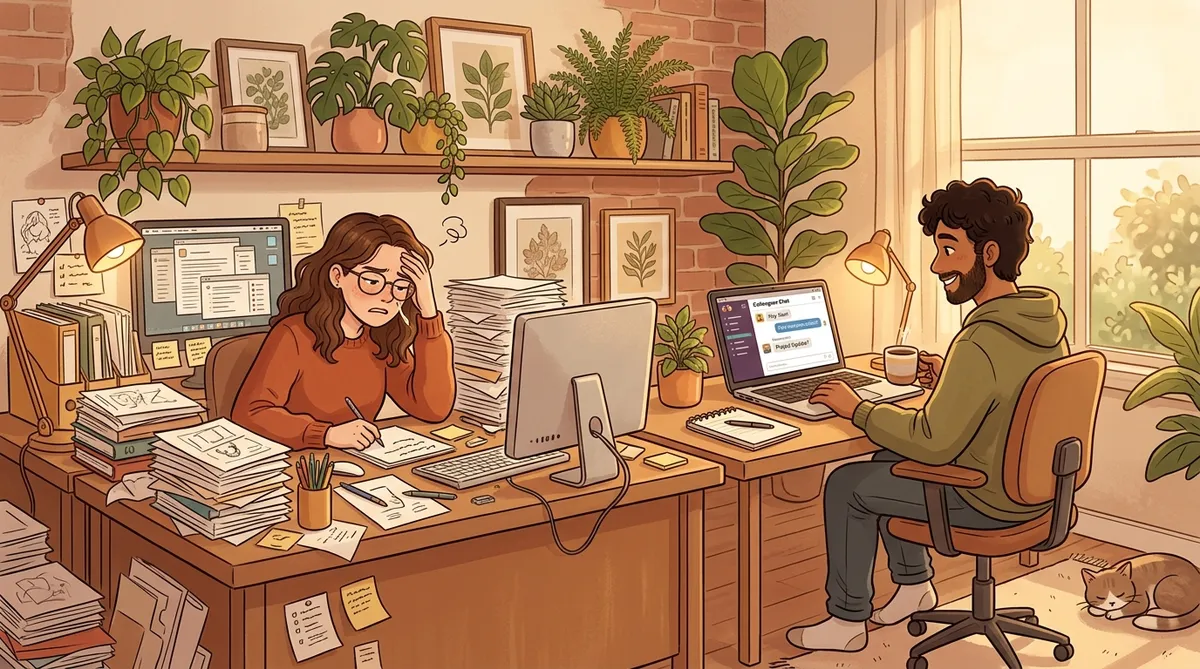
But here’s the thing most of those articles get wrong: AI isn’t replacing people. People who use AI are replacing people who don’t.
That’s not a threat. It’s actually good news, because it means the choice is yours.
Does AI Really Matter?
Yes. But probably not for the reasons you’ve heard.
AI matters because it changes how fast one person can get things done. And not just a little faster. We’re talking 10 to 100 times faster for certain kinds of work.
Think about how much of your week goes into writing emails, putting together reports, organizing information, or tracking down answers. Those are exactly the kinds of tasks where someone using AI finishes in minutes what used to take hours.
A coworker who used to spend all morning writing a weekly status report now gets it done in 10 minutes. Someone in HR who used to take three days to review a stack of resumes now gets through them before lunch. A small business owner who used to spend an hour drafting every customer email now sends polished responses in seconds.
This isn't about the future
The Math Nobody Talks About
Here’s the part that should make you uncomfortable, because it’s already happening.
Someone in your field, doing the same kind of work you do, is using AI to get through tasks 10 times faster. They write reports that used to take a full day in under an hour. They clean up spreadsheets that used to take a week in an afternoon. They draft, edit, and polish documents while everyone else is still staring at a blank page.
Now picture a company looking at those numbers. One person doing the work that used to take ten people. That person would happily take double their current salary. The company would happily pay it, because they just saved eight other salaries. It’s a win for that person. It’s a win for the company.
It’s a loss for the other nine.
This is already happening
This doesn’t mean your job disappears tomorrow. It means the people who learn to work with AI become more valuable, and the gap between them and everyone else gets wider every month.
Four Things AI Can’t Replace
Now for the part that should make you feel better. Because there are things about you that no AI can do, no matter how advanced it gets. These are your real advantages, and they become MORE valuable as AI handles the routine stuff.
Your work ethic. AI doesn’t show up early. It doesn’t push through when things get hard. It doesn’t care whether the job is done well or just done. When a deadline hits and the easy path is to cut corners, you’re the one who stays and gets it right.
Your taste and creativity. AI can generate 50 options in seconds. But it can’t tell you which one is right. You know what looks good, what sounds off, and what fits your situation. AI gives you raw material. You shape it into something worth sharing.
Your relationships. The trust you’ve built over years, the people who pick up the phone when you call, the reputation you’ve earned by showing up and delivering: AI doesn’t have any of that. People work with people they trust.
Your willingness to adapt. You’re reading this article right now. That means you’re already doing it. Most people won’t even look into this stuff. You did. That willingness to learn something new when the world shifts is the most valuable human skill there is.
And here’s why that advantage is permanent, not temporary. AI only knows what it was trained on. It can’t learn from what happens tomorrow. But you can. Every time you use AI in your specific job, with your specific problems, you figure out things that nobody else knows yet, including the AI itself. You build expertise that didn’t exist before you sat down and started working.
The people who stay ahead aren’t the ones who learned AI once and stopped. They’re the ones who keep riding the wave. Every new version of AI gives them a new edge, because they already know how to use the last one. They’re always one step ahead, generating knowledge faster than AI can absorb it.
The real competitive advantage
The Gap Isn’t Technical
Here’s what surprises most people: learning to use AI isn’t a technical skill. It’s a communication skill.
You don’t need to write code. You don’t need to understand how any of it works behind the scenes. You just need to know how to explain what you want clearly enough for your AI assistant to help you.
Think about it like working with a new coworker. They’re incredibly smart and fast, but they don’t know your job yet. Your role is to explain what you need, give them context, and point them in the right direction. The better you get at that, the more useful they become.
Try this right now
Open any AI assistant (ChatGPT, Claude, or Gemini) and type:

"I'm a [your job title]. What are three things you could help me with today that would save me at least 30 minutes?"
That one question might change how you think about your workday.
Starting Is Easier Than You Think
You don’t need to take a course. You don’t need to understand how AI works under the hood. You just need to try it once, for something real.
Pick one thing you do this week that takes longer than it should. Writing an email. Putting together a report. Summarizing meeting notes. Researching a decision. Then open an AI assistant and ask for help with that specific thing.
- Pick one task from your week that takes too long
- Open ChatGPT, Claude, or Gemini (all free to start)
- Describe the task like you’d explain it to a helpful coworker
- Try the result and see how much time it saves
- If it works, try it again tomorrow with something different
That’s it. No big commitment. No learning curve. Just one conversation about one real thing in your life.
The people who are “good at AI” didn’t start with a masterclass. They started with one question, got a useful answer, and kept going.
You’re Not Too Late
If you’re reading this and thinking “I should have started a year ago,” stop. You’re starting now. That’s what matters.
The gap between “never tried AI” and “uses AI regularly” is smaller than you think. It’s one conversation. One task. One small win that makes you wonder why you waited.
The people who get left behind won’t be the ones who were slow to start. They’ll be the ones who never started at all.
You’re not one of them. You’re here.